
Criminal Court Records in Jones County
A criminal court record is the case file a court clerk opens the moment formal charges are filed against a person. It is not a single page. It is a running folder that grows as the case moves, holding the charging document, bond orders, motions, plea petitions, hearing notes, and the judge's final orders. In Jones County, the Circuit Clerk serves as clerk of the Circuit Court, County Court, and Youth Court, so the felony case file and many lesser case files start and stay with that office.
Which court hears a case depends on how serious the charge is. The Circuit Court is the felony trial court and also hears appeals from lower courts. County Court shares some criminal jurisdiction with the Circuit Court. Justice Court handles misdemeanor crimes and traffic matters outside city limits, and Municipal Courts handle city misdemeanors and ordinance cases. A single person can have records in more than one of these courts, so the search often starts with the charge level, not the name.
How to Search Jones County Criminal Court Records
Modern Circuit Court and County Court cases in Jones County live in Mississippi Electronic Courts, the statewide e-filing system known as MEC. Public users reach filed documents through Public Access to MEC, or PAMEC, which requires a registered account and charges for access. The local Jones County Circuit and County Court locations went live on MEC on December 18, 2017, so case files from that date forward are tied to the electronic system.
- Open the Mississippi Electronic Courts landing page and register for a PAMEC account through the online registration site.
- Search by the defendant's full legal name or by the case number if you already have it, and try spelling variations.
- Narrow the result by court, case type, and filing date so a common name returns a workable list.
- Open the case to read the docket, the charge list, and the disposition entry.
- Request a certified copy from the Circuit Clerk if a court or agency needs an official document.
When remote access does not work, call or visit the correct district clerk office. The First District counter is in Ellisville and the Second District counter is in Laurel. For statewide and federal layers, the Mississippi Department of Corrections runs a separate inmate search for people sentenced to state prison, and serious Jones County cases that become federal matters are prosecuted by the U.S. Attorney's Office for the Southern District of Mississippi.
The U.S. Attorney's Office for the Southern District of Mississippi handles federal criminal cases that arise in Jones County, which sits in the Eastern Division.
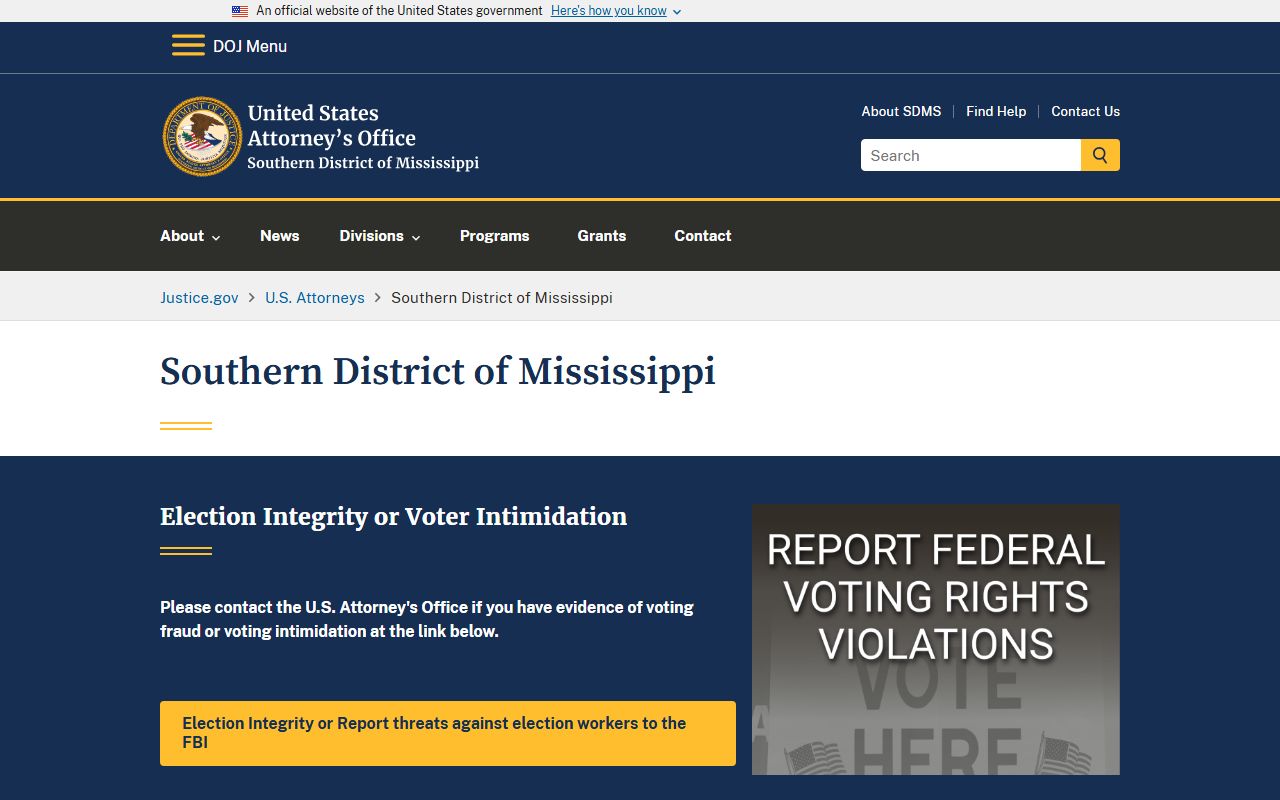
Federal case files are separate from the Jones County Circuit Court file, so a person can have a county record, a state record, and a federal record that do not cross-reference each other.
Stages of a Jones County Criminal Case
A criminal case moves through fixed stages, and each stage leaves an entry in the record. Reading those entries in order is the easiest way to understand where a case stands. The grand jury or the prosecutor files the charge, the court reads it to the defendant, the two sides exchange motions, and the case ends in a plea, a trial, or a dismissal before the judge imposes any sentence.
Case flow: Charges Filed › Arraignment › Pretrial / Motions › Plea or Trial › Disposition › Sentencing
| Stage | What Happens |
|---|---|
| Arraignment | The court reads the charges and the defendant enters a plea of guilty, not guilty, or no contest. MEC may flag the case "Arraignment Pending" until this step is done. |
| Pretrial / Motions | Both sides file motions, share evidence, and argue bond and pretrial release. Diversion or intervention status can appear as "Pretrial Interv Pending." |
| Plea or Trial | The case ends in a negotiated plea or goes to a jury. A docket may read "Plea Pending" or "Trial Pending" while this is unresolved. |
| Sentencing | After a guilty plea or verdict, the judge imposes a sentence, which can include prison, probation, fines, or restitution. |
The District Attorney drives the charging side of this flow. Jones County is served by District Attorney Brad Thompson, who was appointed in 2022. The prosecutor presents felony cases to the grand jury, negotiates pleas, recommends sentences, and can drop a charge through a nolle prosequi entry. Eligible defendants who cannot afford counsel are appointed a defense lawyer, and the court handling the case is the place to confirm that appointment.
What a Jones County Criminal Court Record Shows
A criminal case file in Jones County holds the same core fields whether the case is small or serious. The fields tell the story of the case in plain order: who was charged, with what, how they answered, and what the court ordered. The file may also carry bond figures, court costs, and document images filed as PDFs in the electronic system.
| Field | What It Shows |
|---|---|
| Case Number | The MEC or local court number that identifies the file. Format varies by court and district. |
| Defendant | The person charged. Criminal cases are styled State of Mississippi versus the defendant. |
| Charges | The offenses as filed, tied to a Mississippi statute, each listed as a separate count. |
| Plea | The defendant's formal answer: guilty, not guilty, or no contest where allowed. |
| Disposition | The outcome of each charge, such as guilty, dismissed, acquitted, or nolle prosequi. |
| Sentence | The punishment ordered after a conviction, including prison, probation, fines, or restitution. |
Docket events sit alongside these fields and record every step in date order. The Jones County dockets in MEC use status flags drawn from the 18th Circuit court system, including Bench Warrant Issued, Capias Pending, MDOC Warrant Issued, Probation, Probation Violation Pending, and Register as Sex Offender. These flags are a fast way to see what a case is doing without reading every order. The charge list itself is best read against the Jones County court charge records, which explain how each count is filed and how its status can change.
Charges vs. Convictions
Being charged is not the same as being convicted. A criminal court record can list a charge that was later dropped, dismissed, or ended in an acquittal. A charge is only an accusation that the prosecutor must still prove. A conviction is the court's finding of guilt, reached by a plea or a verdict. Readers who confuse the two can draw the wrong conclusion from a file, so the distinction matters.
| Charge | Conviction | |
|---|---|---|
| Stage | Accusation | Verdict or plea |
| Burden of Proof | Probable cause | Beyond reasonable doubt |
| Public Record | Yes | Yes |
Note: A dismissed or nolle prosequi charge still appears in the public file unless a court later expunges or seals it under Mississippi law.
Reading Jones County Criminal Dispositions and Sentences
The disposition is the heart of a criminal court record. It tells you how each charge ended. Common dispositions in Jones County files include guilty, not guilty, dismissed, and nolle prosequi, which is the prosecutor's formal decision not to pursue a charge. A no contest plea, where allowed, accepts the penalty without admitting guilt.
The sentence follows a conviction and may run several lines. It can set a prison term, place the person on probation, or order fines, court costs, and restitution. Jones County dockets may then show later flags such as Probation, Probation Violation Pending, Revocation Order to be entered, or Final Judgment Issued. Reading these flags in date order shows whether a sentence is active, completed, or back before the court. A capias or bench warrant flag usually means the defendant failed to appear or did not comply with an order.
Sealed vs. Expunged Records
Some Jones County criminal records are removed from public view. A sealed case is restricted from ordinary public searching but still exists. An expunged case is treated under the law as though it never happened, and the MEC flags EXPUNGED and SEALED mark these files so they no longer return in normal results. Expungement in Mississippi runs through Miss. Code Ann. Section 99-19-71 and depends on the type of charge, the disposition, and a waiting period.
| Sealed | Expunged | |
|---|---|---|
| Visibility | Hidden from public | Destroyed / treated as never existed |
| Law Enforcement | Limited access | Very limited |
| Eligibility | Set by court order or statute for restricted matters | Eligibility-specific under Miss. Code § 99-19-71 |
To seek an expungement, a person files a petition in the court that handled the case, usually Justice, Municipal, County, or Circuit Court. The petitioner gathers the case number, the arresting agency, the charge, the disposition, and proof that any sentence was finished. The exact text and current eligibility rules can be read in the Mississippi Legislature statute reference for Section 99-19-71.
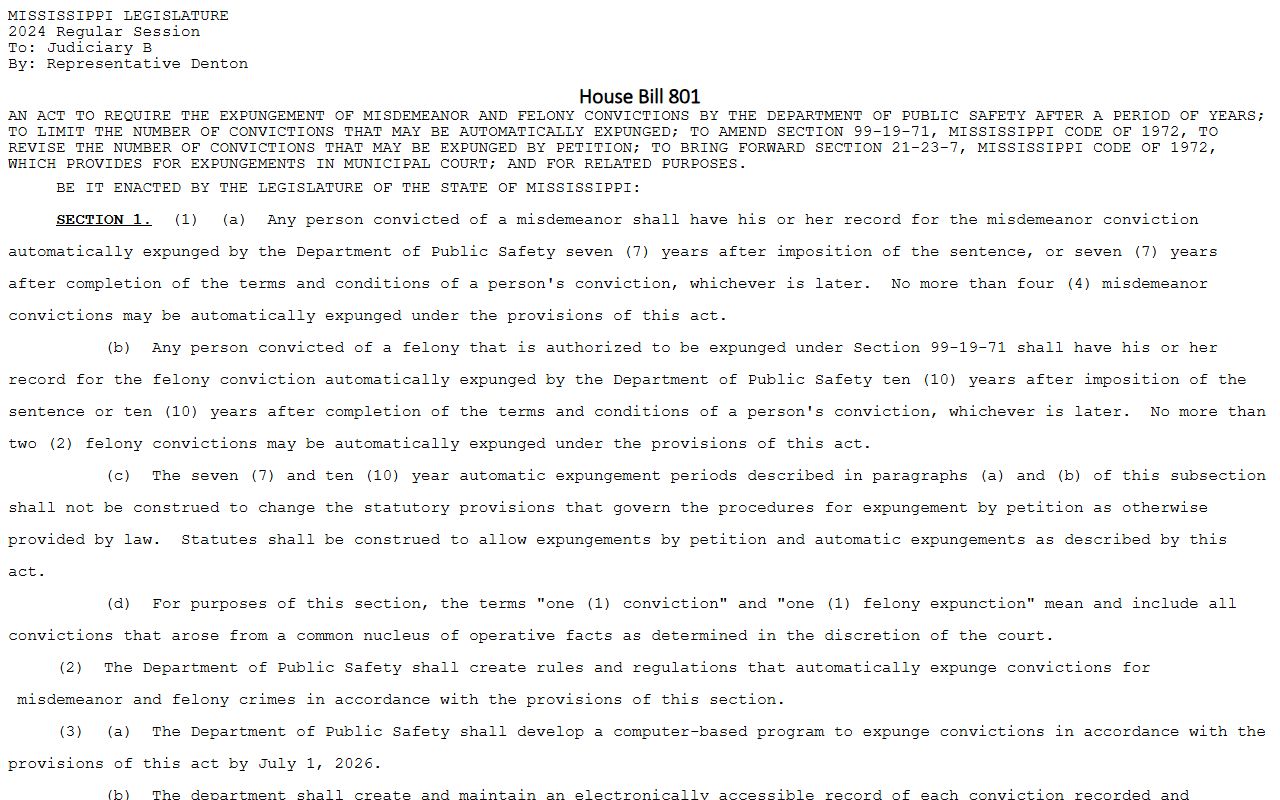
The statute does not promise that every arrest, misdemeanor, or felony can be cleared, so a person should confirm eligibility before paying any filing fee.
Public Access to Jones County Criminal Court Records
Mississippi law starts from the position that public records are open. Court files are presumed available for inspection unless a statute, a sealing order, or a confidentiality rule says otherwise. Criminal case files are public records, but sensitive identifiers inside them, such as Social Security numbers and dates of birth, are redacted from public images. The custodian for a Circuit or County Court file is the Jones County Circuit Clerk.
Key Statutes:
Mississippi Code Title 25, Chapter 61 - the Public Records Act makes government records open for inspection unless the law provides an exemption.
Mississippi Electronic Courts Administrative Procedures - define electronic filing, public access through PAMEC, and which matters are restricted from remote viewing.
The same open-records framework that opens county files also covers federal prosecutors who handle Jones County cases. The U.S. Attorney's Office contact page lists the Jackson and Gulfport offices for the Southern District of Mississippi.
Federal docket entries and documents are reached through the federal PACER system rather than the county clerk, so a federal Jones County case follows a different access path than a Circuit Court file.
Background Check Considerations
People search criminal court records for many reasons, but not every search is allowed for every purpose. A casual look at a public docket is one thing. A formal background check used for hiring, housing, or credit is governed by the federal Fair Credit Reporting Act and must run through a regulated agency. The official file held by the Circuit Clerk is the most reliable source, since convenience copies and third-party sites can lag behind the court.
Important: This website is not a consumer reporting agency under the Fair Credit Reporting Act, and its records may not be used to decide employment, housing, credit, or insurance.
Restricted Criminal Court Records in Jones County
Several kinds of criminal matters are not open to the general public. Youth Court records are confidential under Mississippi law, and the County Court handles those juvenile matters. Sealed and expunged files do not return in ordinary searches, and the clerk may confirm only limited procedural facts or nothing at all. Active investigative warrants and some pretrial materials can also be withheld while a case is open.
When a record is restricted, the answer is rarely a public database. The path forward is to identify the custodian, confirm whether you have standing as a party or attorney, and ask the court directly. A criminal file is one slice of a larger index, and the broader set of civil, family, and probate filings sits in the Jones County court records system. The criminal court file itself picks up only once formal charges are filed.